
Guitar Code Chart
Most guitar songs use a handful of open chords, plus barre chords that move the same shape up and down the neck. This chart shows both: pick a root and chord type to see the familiar open fingering where one exists and the E-shape and A-shape barre versions, drawn as standard chord diagrams. Add chords to a sheet and print it for your music stand.
- Free to use
- No sign-up
- Runs in your browser
Guitar chord chart
Guitar Chord Chart Pack
Printable guitar chord charts: essential open chords, E- and A-shape barre chord charts in every key, blank chord diagram sheets and a practice log.
- Open chords (PDF/XLSX)
- Barre chords (PDF/XLSX)
- Blank diagrams (PDF)
- Practice log (PDF/DOCX/XLSX)
Formats: PDF, XLSX, DOCX. Instant download after payment (link valid 72 hours, up to 5 downloads). AI-assisted: the templates were drafted with AI help and reviewed and laid out before publishing.
$3.00 USD, one-time 4 files · about $0.75 each
- Instant download
- 7-day refund
- Secure checkout by Stripe
7-day money-back guarantee. Full refund within 7 days of purchase, even after you download.
Free sample: Barre Chords All Keys (PDF, 54 KB)
Full refund within 7 days — see the refund policy and license.
Free printables
Single sheets you can print right now, no sign-up. The full pack adds every sheet in one download plus the editable files.
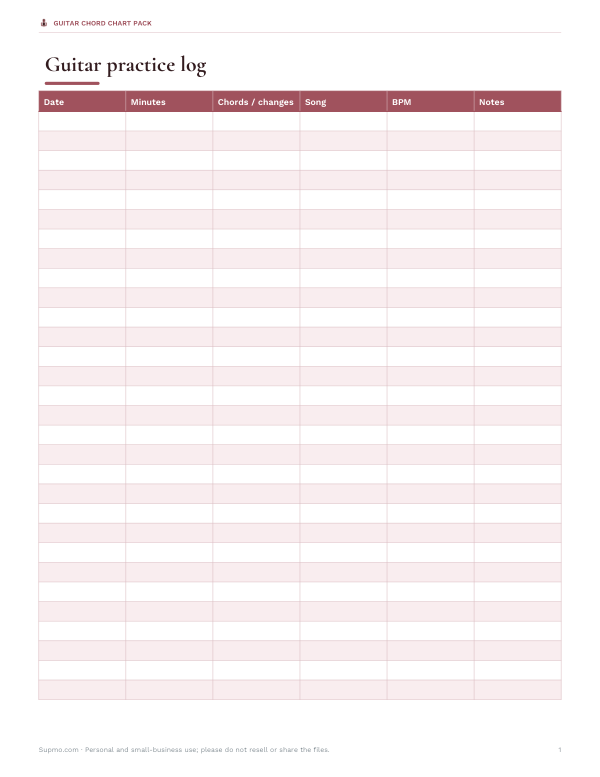 Printable Guitar Practice Log
How to read a chord diagram
| Symbol | Meaning |
|---|---|
| Vertical lines | Strings: low E (6th) on the left to high E (1st) on the right |
| Horizontal lines | Frets; a thick top line is the nut |
| Dot | Where to press |
| ○ above a string | Play the string open |
| × above a string | Don’t play that string |
| Curved bar | Barre: one finger presses several strings |
| “5fr” | The diagram starts at the 5th fret |
| x32010 | Text version, low E to high E; x = muted, 0 = open |
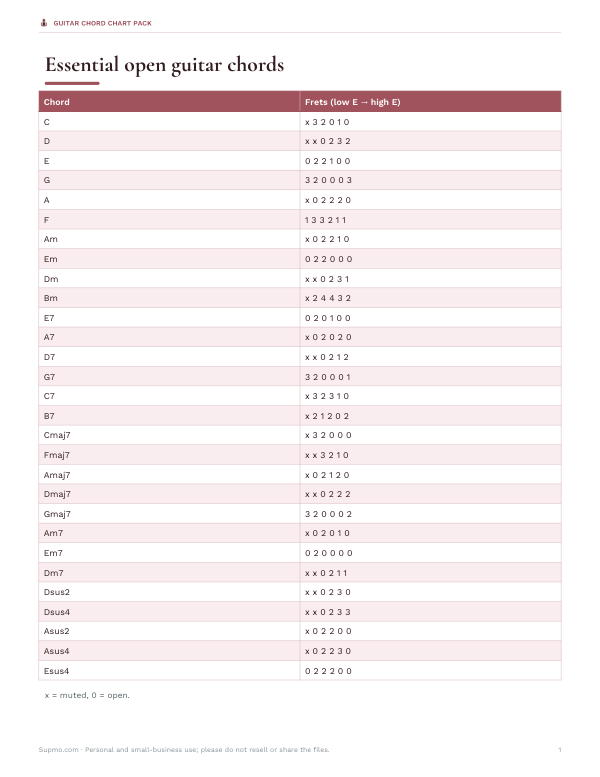
The essential open chords
| Chord | Fingering (low E → high E) |
|---|---|
| C | x 3 2 0 1 0 |
| D | x x 0 2 3 2 |
| E | 0 2 2 1 0 0 |
| G | 3 2 0 0 0 3 |
| A | x 0 2 2 2 0 |
| F | 1 3 3 2 1 1 |
| Am | x 0 2 2 1 0 |
| Em | 0 2 2 0 0 0 |
| Dm | x x 0 2 3 1 |
| Bm | x 2 4 4 3 2 |
| E7 | 0 2 0 1 0 0 |
| A7 | x 0 2 0 2 0 |
| D7 | x x 0 2 1 2 |
| G7 | 3 2 0 0 0 1 |
| C7 | x 3 2 3 1 0 |
| B7 | x 2 1 2 0 2 |
| Cmaj7 | x 3 2 0 0 0 |
| Fmaj7 | x x 3 2 1 0 |
With G, C, D, Em and Am you can play thousands of songs. F and Bm are shown as barre chords because they have no easy open shape.
Barre chords: one shape, every key
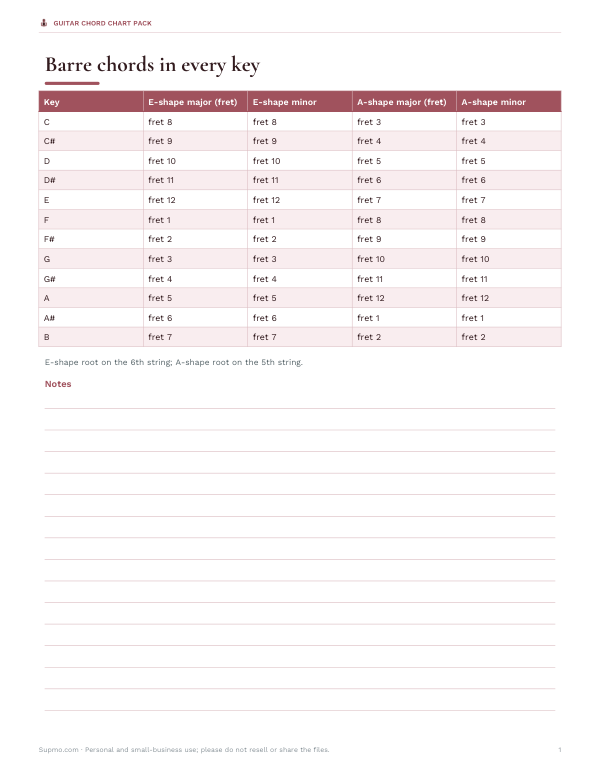
A barre chord uses one finger across the strings at a fret, with the rest of the hand making a familiar open shape. The E-shape barre takes the open E chord and moves it up the neck: its root is on the 6th string, so at the 3rd fret it is G, at the 5th it is A. The A-shape barre is the open A chord moved up, with its root on the 5th string: at the 3rd fret it is C, at the 5th it is D. Minor, 7th and other types follow the same idea using the open Em, E7, Am, A7 shapes.
Root notes on the neck
| Fret | 6th string (E-shape root) | 5th string (A-shape root) |
|---|---|---|
| 1 | F | A#/Bb |
| 2 | F#/Gb | B |
| 3 | G | C |
| 4 | G#/Ab | C#/Db |
| 5 | A | D |
| 6 | A#/Bb | D#/Eb |
| 7 | B | E |
| 8 | C | F |
| 9 | C#/Db | F#/Gb |
| 10 | D | G |
| 12 | E | A |
Worked example
A song uses G, D, Em and C. Typing them into the song chords box shows the four open shapes: G (320003), D (xx0232), Em (022000) and C (x32010). To play the same progression higher, choose the barre versions: G at the 3rd fret (E-shape), D at the 5th fret (A-shape), Em at the 7th fret (A-shape minor) and C at the 3rd fret (A-shape) — useful for a brighter sound or for keeping the hand in one area.
Practice tips
- Press just behind the fret, with fingertips arched so they don’t mute neighbouring strings.
- Practise changing between two chords for a minute at a time.
- Keep a “pivot” finger on the same string between chords when possible.
- Build barre strength gradually — start with the partial barre on F (xx3211).
- Use a capo to play open shapes in other keys.
Using a capo
A capo clamps across the strings at a fret and raises every open chord by that many semitones. With a capo at the 2nd fret, the open G shape sounds as A, C sounds as D and so on. Singers use a capo to move a song into a comfortable key without learning new shapes, and guitarists use it to keep the ringing open-chord sound in keys like B♭ or E♭ that have few open chords.
Common chord progressions
| Progression | In G | In C | Heard in |
|---|---|---|---|
| I–V–vi–IV | G D Em C | C G Am F | Countless pop songs |
| I–IV–V | G C D | C F G | Rock, folk, blues |
| ii–V–I | Am D G | Dm G C | Jazz |
| I–vi–IV–V | G Em C D | C Am F G | 1950s ballads |
| 12-bar blues (7ths) | G7 C7 D7 | C7 F7 G7 | Blues and rock ’n’ roll |
Type any of these into the song chords box to see all the shapes together.
Chord types in brief
| Type | Formula | Sound |
|---|---|---|
| Major | 1 3 5 | Bright |
| Minor | 1 ♭3 5 | Darker |
| 7 | 1 3 5 ♭7 | Bluesy, wants to resolve |
| maj7 | 1 3 5 7 | Smooth, jazzy |
| m7 | 1 ♭3 5 ♭7 | Mellow |
| sus2 | 1 2 5 | Open, ambiguous |
| sus4 | 1 4 5 | Tension that resolves to major |
Privacy
The chart runs in your browser.
Frequently asked questions
How do I play a G chord?
Open G: 320003 — fingers on the 3rd fret of the 6th string, 2nd fret of the 5th and 3rd fret of the 1st.
What is a barre chord?
A chord where one finger presses several strings at the same fret, letting you move shapes up the neck.
What does x32010 mean?
Fret numbers from low E to high E: x = don’t play, 0 = open.
What are the easiest guitar chords?
Em, Am, E, A, D, C and G are common first chords.
How do I play F without a full barre?
Try the partial F: xx3211.
Can I print the chords for a song?
Yes — type the chords and press Print chord sheet.